 The 1988 Ramon Magsaysay Award for Public Service The 1988 Ramon Magsaysay Award for Public ServiceBIOGRAPHY of Masanobu Fukuoka The ultimate goal of farming is not the growing of crops, but the cultivation and perfection of human beings. - Masanobu Fukuoka MASANOBU FUKUOKA was born on the Japanese island of Shikoku on 2 February 1913. Iyo, his birthplace, is a small town on the west coast, sixteen miles from the city of Matsuyama. His family had been settled there for hundreds of years. On Iyo's hillsides overlooking Matsuyama, his father, Kameichi Fukuoka, cultivated mandarin oranges (tangerines). These orchards, combined with extensive rice lands below, made Kameichi the largest landowner in the area. Kameichi was an educated man, having completed eight years of schooling, which was exceptional for his day. Repeatedly the local leaders selected him mayor. FUKUOKA’s mother, Sachie Isshiki, was of Samurai descent and also well-educated. She was gentle, whereas his father was strict and permitted no luxuries in the household. Even so, FUKUOKA remembers a childhood of ease. Tenants tilled the family rice lands. As the second child of six and eldest son, his only chore was to gather wood after school each day. The family was Buddhist but was tolerant toward Christianity, which had penetrated the Iyo region long before; as a boy FUKUOKA was accustomed to seeing Christian symbols incorporated into household Shinto shrines. Years later he would send two of his daughters to missionary schools. FUKUOKA’s own education began in Iyo's local elementary school, but for middle and high school he had to travel to Matsuyama. Thus, for many years he rode his bicycle daily to Iyo Station, took the train to the city, and went the rest of the way on foot—about half an hour's walk. He claims to have been an inferior student who infuriated his teachers. (One day, in a rage over his misbehavior, the music teacher slammed down the top of the village's only organ so hard that it broke.) Although lessons did not interest him, the boy was impressed by the advice of his literature teacher who urged each student to make five fast friends during his lifetime so that there would be five people to weep for him when he died. As it was expected that FUKUOKA would inherit the family farm, his father sent him for higher education to Gifu Agricultural College, near Nagoya, on the main island of Honshu. Gifu was a three-year state college where students learned modern techniques for largescale farming. Once again FUKUOKA was an indifferent student who preferred to spend his time horseback riding and "fooling around"; student life was generally idyllic and irresponsible. However, a feeling of impending crisis swept the school in 1932 when Japan annexed Manchuria. FUKUOKA and his fellow students detested the intensified military training they were now obliged to undergo. At Gifu, FUKUOKA specialized in plant pathology under the eminent Professor Makoto Hiura. He found good company among the students who gathered in Hiura's office to help with the professor's research and to chat. As jobs were scarce when FUKUOKA graduated in 1933, Hiura persuaded him to continue his research at Okayama Prefecture Agricultural Experiment Station. The following year Hiura found him a position in the Yokohama Customs Office, where he was assigned to the Plant Inspection Section. In its laboratory perched on top of a hill overlooking the city's port, FUKUOKA studied diseases, fungi, and pests found on imported fruits and plants, spending his time, as he later recalled, "in amazement at the world of nature revealed through the eyepiece of the microscope." Every three days he took his turn inspecting incoming plants directly. During his time off, he enjoyed the life of the town and "fell in and out of love" several times. In his third year at Yokohama, however, he was struck down by acute pneumonia, or incipient tuberculosis. Hospitalized, he was subjected to wintry-cold air as part of his treatment. His friends avoided him, fearing contagion. Even the nurses fled after taking his temperature because the room was so cold. Sick and lonely, FUKUOKA feared for his life. He was twenty-five. When he finally recovered and returned to work, FUKUOKA remained distracted by his harrowing brush with death and he began brooding obsessively about life and what it was meant to be. One night during a long solitary walk on the hill overlooking Yokohama he approached the edge of a cliff. Looking down, he wondered what would happen if he fell from the cliff and died. Surely his mother would cry for him, but who else? Overcome by realization of his failure to acquire five true friends, he collapsed into a deep sleep at the foot of an elm tree. He awoke at dawn to the cry of a heron. He watched the sun break through the morning mist. Birds sang. At this moment FUKUOKA had a revelation: "In this world there is nothing at all." There was no reason to worry about life. As he wrote later, he suddenly understood that "all the concepts to which he had been clinging were empty fabrications. All his agonies disappeared like dreams and illusions, a something one might call 'true nature' stood revealed." FUKUOKA embarked immediately upon a new life. The next day quit his job and set off gaily on an aimless journey. He wandered the sea, to Tokyo, to Osaka, Kobe, and Kyoto, and finally to the southern island of Kyushu. For months—he himself doesn't know how many—he lived on his severance pay and the generosity of others he jubilantly broadcast his newfound belief that "everything is meaningless." But people dismissed him as an eccentric and he fine went home and retreated to a simple hut on the mountainside. He entrusted with his father's richly-bearing citrus grove, he beg putting his revelation to a practical test—by doing nothing! Convinced that everything should be allowed to take its natural course, FUKUOKA left the meticulously pruned fruit trees to nature. He then watched as insects attacked, branches interlocked, and orchard began withering away. His father's decimated grove provided FUKUOKA his first important lesson in natural farming: you cannot change agricultural techniques abruptly—trees that have been cultivated cannot adapt to neglect. In 1939 Japan's deepening involvement in military expansion abroad interrupted FUKUOKA’s rustic existence. Besides the fact his parents' concern over his odd behavior, it was no longer considered appropriate for the son of the mayor to be "hiding" in the hills. About the same time, he was offered the post of chief of the Disease and Insect Control Section of the Kochi Prefecture Agricultural Experiment Station. Acceding to his father's wishes, he accepted. He moved to remote Kochi, on the other side of Shikoku Island, a remained there for the next five years. At Kochi, FUKUOKA and his colleagues were expected to increase wartime food production, especially through advances in scientific agriculture. While concentrating on research, FUKUOKA also advised farmers about chemical farming and wrote a "farming tips" column for a local newspaper. On his own, however, he conducted comparative studies. He compared yields from intensively cultivated crops enhanced with compost and chemical fertilizers and pesticides those achieved from crops grown without chemical additives. His conclusion was that the use of fertilizers and pesticides was not really necessary. Although these additives resulted in a marginally higher yield, the value of the yield did not exceed the cost of achieving. Thus, at Kochi FUKUOKA established to his satisfaction the superiority of natural farming over farming with chemical aids. Building upon his earlier revelation that "doing nothing was best," these studies laid the scientific basis for his lifework. During holidays from the research station, FUKUOKA visited his family in Iyo. On one of these visits in the winter of 1940, a local matchmaker introduced him to six young women, one of whom, Ayako Higuchi, pleased him and agreed to be his wife. They were married in the spring. The first of their five children, daughter Masumi, was born the following year, to be followed in due course by a son, Masato, and three more daughters, Mizue, Mariko, and Misora. At Kochi, far from home and the battlefields, FUKUOKA philosophically pondered the problems of war and peace. At one point, he drafted his ideas in a letter to the president of the United States. He cannot remember whether he mailed it. Later, in Mu: The God Revolution, he compared the conflict among animals in nature with war among humans and concluded that only man's conflicts are fought with love and hate, and it is these conflicts that are truly savage. In the tradition of Zen Buddhism, he believes that love and hate are two sides of the same coin, both are qualities of man alone, and both are but clouds of illusion. He concludes that in the final analysis, man's so-called love is merely love of self. FUKUOKA was finally conscripted in the last desperate months of the war. His duty, from May until August 1945, was helping build mountain redoubts to prepare for the defense of his island homeland. He did his best to become a good soldier, he says, but looking back realizes that in the military "you lose all the faculty of thought and become like a worm. That is the most horrible part of the war." The war's sudden end "exalted him." He and his fellow soldiers "scraped the Emperor's chrysanthemum seal from their weapons," cast their guns away, and went home. The first months of the Allied Occupation of Japan were traumatic. Local officials like FUKUOKA’s father were purged from public office, and in October General Douglas MacArthur, head of the occupying forces, proclaimed land reform. FUKUOKA’s father, in a fit of remorse over his past life as a prosperous landlord, gave up more land than was required, which left the family with only three-eighths of an acre of rice land. But because land reform applied only to rice lands, the citrus orchards in the hills were still theirs. Here, FUKUOKA once more took up his pursuit of a way of farming fully integrated with nature. What he had learned from his earlier farming experience was that no area, once cultivated, was natural. Orchards were quite unnatural. And trees accustomed to pruning would not fruit well with the sudden withdrawal of pruning care. From this, FUKUOKA realized that to grow food by "doing nothing" would require a framework of effort. His task? To create a food-producing environment that diverged as little possible from what he considered a natural one. To learn how to accomplish this, FUKUOKA says, "I just emptied my mind and tried to absorb what I could from nature." For the next few years, therefore, he observed which plants and animals lived naturally on his small piece of earth. He scattered fruit, vegetable and tree seeds randomly and watched as some of them rooted a thrived while others died. (Cypress, cedar, and orange trees grow best in the rich soil of his orchard; cherries, peaches, pears, and plums in the thinner soil.) Proceeding by trial and error, he farmed the land passively. Instead of asking, "how about doing this?" asked, "how about not doing this?" Over the years his original insight about natural farming was borne out. As a more natural ecology was re-established, the less he did, the better the land respond This is why his Four Principles of Natural Farming, as he eventually summarized his experience, compose a list of things not to do. � The earth cultivates itself, observed FUKUOKA. There is no need for man to do what roots, worms, and micro-organisms do better. Furthermore, plowing the soil alters the natural environment and promotes the growth of weeds. Therefore, his first principle is: No plowing or turning of the soil.Thus FUKUOKA evolved his techniques for natural farming by the process of elimination. Along the way he also abandoned the water-filled paddy field and stopped planting seeds beneath the ground in tidy rows. He stopped chopping up straw and laying it neatly upon the fields as most Japanese farmers were wont to do. Straw worked best, he found, if it is scattered whole upon the ground. In these ways, FUKUOKA abandoned the artful tidiness of traditional Japanese farms and the regimentation of modern ones, in favor of the unkempt exuberance of natural growth. FUKUOKA’s "direct-seeding, non-cultivation, winter grain/rice succession" illustrates the application of his principles to grain growing and shows his natural farming to be both simple and complex. In the fall, as his rice plants reach maturity, FUKUOKA scatters seeds among the browning stalks: winter grain (rye, barley, or wheat), white clover, and rice. (Seeding amidst the rice makes it harder for birds to get at the new seed.) After the rice is harvested in October FUKUOKA covers the field with its straw. This protects the seeds and inhibits weeds. Clover and the winter grain soon grow through the mulch; the rice lies dormant until spring. In the months that follow, the grain stalks rise above the clover; the grain matures in May. FUKUOKA cuts it, spreading it on the field to dry, and then threshes, winnows, and sacks the grain, re-covering his fields with the stalks. Now briefly he introduces water into the field. This loosens the clover and weeds and permits the rice seeds to sprout. After he drains off the water the clover recovers and grows heartily beneath the rice plants. Once again in August FUKUOKA briefly floods the field. In October, before the rice is harvested and threshed—all with tradition Japanese tools—the cycle begins again. It should be noted that FUKUOKA is building upon and refining Japanese agricultural practices that are centuries old: planting alternating crops of rice and winter grain each year without depleting the soil. The major differences are, in traditional farming, rice seedlings are transplanted from starter beds, the rice is grown in standing water and the fields are weeded. Straw, for the traditional farmer, as for FUKUOKA, has always been an essential mulch. As a compost straw enriches the earth, and as a ground cover it inhibits weeds, fosters germination, frustrates birds, and retards water evaporation. A difficulty with FUKUOKA’s non-plowing, direct-seeding method planting is that exposed seeds become prey to birds and animals. By casting the seeds amidst a standing crop and covering them with straw, the birds can be kept at bay, but moles, crickets, slugs, and mice present another problem. For many years FUKUOKA thwarted foraging insects and rodents by pelletizing his seeds, that is, by encasing them in clay. Pelletizing seeds also keeps them from rotting if the season is unusually wet. However, by keeping a natural balance in the animal kingdom FUKUOKA now seldom needs to coat his seeds, thus eliminating another task. FUKUOKA has been refining his grain-growing method for over thirty years. Despite the skepticism of agricultural experts his untidy, naturally watered (forty to sixty inches annually) grain fields achieve yields equivalent to and sometimes surpassing those of intensive cultivated and irrigated fields that are treated with the latest commercial inputs. At the same time, as he likes to point out, his soil becomes richer and richer. His orchards have also thrived under this regime of attentive inattention. As he learned very early, simply abandoning already cultivated fruit trees to grow on their own had disastrous results. It was necessary first to restore a natural environment to the hillside, in which fruit trees could flourish with minimum pruning and, in keeping with his four principles, without tilling, weeding, or applying fertilizers or pesticides. As with his grain fields, years of trial and error passed before FUKUOKA could grow mandarin oranges and other fruits by "doing nothing." Beginning immediately after the war with 1.75 (later expanded to 10) acres of his father's aging and depleted citrus trees, FUKUOKA addressed two fundamental problems. First was how to restore and enhance soil fertility without using fertilizers. Second was how to restore the heavily pruned trees to their natural form so that eventually, he hoped, they would require no pruning. To restore fertility FUKUOKA proceeded on the premise that ground cover—green manure—might best rehabilitate the clay soil. He experimented by scattering on the ground the seeds of thirty grasses, crucifers (e.g., turnips, cabbages, radish), and legumes (peas, soybeans), studying their growth carefully. In time he adopted ladine clover as his primary hillside ground cover. Ladine clover suppresses weeds, improves the soil, and does not compete with the fruit trees for moisture or nutrition; moreover, it is hardy and need be sown only once in six or eight years. He found alfalfa, lupine, and bur clover useful as secondary cover. The more he departed from monoculture, the more fertile the soil became. He planted myrtle and acacia trees whose roots penetrated to a deeper stratum of the soil, loosening it and adding nutrients such as phosphoric acid, potash, and nitrogen. And he interplanted the trees with shrubs and climbing fruit vines. Although mandarin oranges dominated, eventually some thirty varieties of fruit trees grew amidst the botanic profusion of his three-dimensional (vegetables, shrubs, trees) orchard. Meanwhile the hard red clay soil, he says, "became loose, dark-colored, and rich with earthworms." FUKUOKA acknowledges that this method of improving the soil takes a long time. In five to ten years there may be six inches of new topsoil. But, he points out, trees grown under these conditions live much longer than those tended and cared for. What is more, based upon standard criteria for comparison—tree growth and quality and quantity of fruit—he claims his "thirty years of natural farming compare favorably with scientific farming in every respect." (By quality, however, he means his own definition of the word. In his book The Natural Way of Farming [1985] he spends a number of pages urging the public to eat foods "nature intended," not those their taste buds desire.) As regards pruning, FUKUOKA learned that once a fruit tree has been pruned, it must be pruned forever after. Consequently he experimented with a new type of pruning designed to mold trees back to their natural shape. Discovering what was the natural shape of an orange or cherry tree was not easy; what was commonly presumed to be natural was really the shape of the pruned tree after it had been abandoned. Because virtually all fruit trees have been cultivated by man and their seeds bear the results of cross-breeding, FUKUOKA concluded that "no one has ever really seen a totally natural fruit tree." To discover the natural shape of fruit trees, therefore, FUKUOKA studied other kinds of trees that still grew wild in the forest. For instance, forest-grown pines and cedars have straight trunks; the branches are spaced so that they do not cross and so maximum sunlight reaches all the leaves. Under ideal conditions, he insist "no matter how small the plant or large the tree, every leaf, every shoot and branch grows out from the stalk or trunk in an order and regular arrangement." Eventually FUKUOKA was able to establish "with considerable certainty" the optimal natural forms for many trees in his orchard including several varieties of orange as well as persimmon, chestnut, pear, apple, and loquat. He then sought, by careful and discreet pruning, to induce his trees to conform to the model. FUKUOKA’s interventions in the growth of his fruit trees differ radically from those of conventional orchardists. Whereas the lab seek to shape the tree to facilitate fruiting and efficient cultivation and harvesting, he seeks to shape trees in accordance with what conceives to be nature's original design. He maintains that the more his trees are encouraged in a natural shape and provided with greater growing space, the less pruning they require. Increasingly he says, he can take it easy and "let the orchard grow itself." Vegetables growing semiwild are an important part of this three-layered orchard ecosystem. FUKUOKA’s planting technique is to broadcast the seeds and let the plants grow randomly among the clover, weeds, and trees. Here, too, an intimate awareness of natural patterns is necessary. By trial, error, and keen observation FUKUOKA has learned how to introduce vegetables into the ecosystem at the right time and in the right way. To sow winter vegetables, for example he waits until the wild summer grasses are drying. Then, after a good rain, he cuts back the grasses, scatters the vegetable seeds, and covers them with the freshly cut grass. The seeds germinate safely beneath the mulch and gain a head start on the winter weeds. The latter FUKUOKA cuts back a few times until the new vegetables can compete on their own. Similarly, summer vegetables are planted just as the winter weeds are losing their vigor. Chickens and birds will eat some of the seeds but many will survive to germinate. Some vegetables need more help. FUKUOKA starts tomatoes and eggplants in a seedbed and transplants them. He soaks and pelletizes the difficult-to-germinate seeds of carrots and spinach. Once they are established, however, he does not pamper them: tomatoes run free along the ground, and cucumbers, melons, and squash stretch out over sticks of bamboo and discarded tree branches. FUKUOKA found that vegetables grow heartily in a semiwild state. One planting of chayote can expand over an area of 100 square yards and bear 600 fruits. Moreover, once started, many vegetables come up year after year, e.g., garlic, Japanese pearl onions, Chinese leeks, potatoes, and taro. Unharvested, daikons (Japanese radishes), turnips, and carrots reseed themselves and produce first-generation hybrids—giant vegetables whose strong taste, FUKUOKA believes, is like that of their wild predecessors. Other vegetables grown in a semiwild state have a "more subtle flavor" than the cultivated ones. (The question is, of course, whether consumers are willing to buy either more strongly flavored or less flavorful vegetables than those they are accustomed to.) Already in his early years at the Kochi Prefecture Agricultural Experiment Station FUKUOKA realized that he, and the other scientists and Japan's highly bureaucratized food authorities whom he views with scorn and often criticizes, were heading in almost diametrically opposite directions. By the 1970s highly commercialized scientific farming had transformed the Japanese countryside. Farmers no longer produced food for their own families and for local markets but found themselves enveloped in the complex web of modern agribusiness. Prompted first by the need to feed Japan's growing population, and later by the demands of affluent urbanites, they scurried to keep up with the latest high-yielding varieties of grain, fruits, and vegetables, and with the fertilizers and pesticides to grow them. Eventually farmers also learned to use dyes, waxes, and preservatives to bring "perfect" fruits and vegetables to market. The number of persons engaged in farming declined dramatically and farms came to resemble mini-factories. Meanwhile, state-sponsored agricultural scientists provided ever newer seeds and chemicals to keep farmers just ahead of the latest plagues, blights, and consumer trends. In the midst of this huge transformation, FUKUOKA’s farm and orchard seemed primitive and irrelevant. This was all the more true because, although he occasionally reported some of his findings in agricultural journals and forums, he had little contact with anyone outside his village. He devoted himself instead to what he later called "the road of a dilettantish farmer tilling a lost paradise." For all its satisfactions this kind of life did not bring him serenity. "I was a disagreeable presence even to those in my family," he recalls. His belief that headlong industrialization of agriculture in Japan was not only wasteful and unnecessary, but also highly destructive to the earth—perhaps irrevocably so—caused him in the mid-1970s to formulate his philosophy to reach a public audience. In Shizen Noho Wara Ippon no Kakumei [1975]—translated into English in 1978 as The One Straw Revolution—he distilled his experience of the past thirty years. He not only introduced his principles of natural farming but put forward his understanding of how natural farming related to larger issues. The book bore a powerful message: mankind, seduced by its intellect into thinking it could conquer nature, was launched upon a dangerous path. In the short run, chemical-driven scientific agriculture undeniably produced abundance. But by intervening in nature with machines and chemicals; scientific agriculture would backfire in the long run. Eventually it would deplete the earth's natural fertility, denude its forests, and poison its streams, rivers, seas, and ground with the toxic residues of pesticides, herbicides, and fertilizers. At the same time, weak, chemical-dependent hybrid plants would take the place of the nutritious nature-hardened fruits, vegetables, and grains of the past. The problem was so comprehensive, he avowed, that no amount of tinkering could solve it. (Short-term science-led advances—"safer" pesticides, for example—addressed symptoms of the disease, but not the disease itself.) The only real solution was a wholly different approach to food production which restored man's subordinate relationship to nature. This, of course, was the fundamental idea behind FUKUOKA’s "do nothing" farming. FUKUOKA also pointed out that many people had a stake in the scientific approach. These included the manufacturers of agricultural chemicals and equipment and affiliated bankers; politicians who spoke for agribusiness; bureaucrats in the Ministry of Agriculture; and agricultural scientists, virtually all of whom did state-sponsored research in public institutions. Consumers themselves were to blame. By insisting upon blemish-free, cosmetically enhanced produce, and upon fruits and vegetables out of season, they virtually compelled farmers to adopt the latest chemicals and processing techniques. Ironically, he averred, in doing so consumers were passing up the tasteful, nutritious foods of nature's garden—which might, it is true, have a rougher appearance—in favor of the nutritionatrophied products of the assembly line. All of this convinced FUKUOKA that modern man was suffering from a pervasive spiritual decay, a barrenness of the soul caused by his lost intimacy with God and nature. The One Straw Revolution, in short, was FUKUOKA’s plea for man to reexamine his relationship with nature in its entirety. In his most utopian vision all people would be farmers. If each family in Japan were allotted 1.25 acres of arable land and practiced natural farming, not only could each farmer support his family, he wrote, but each "would also have plenty of time for leisure and social activities within the village community. I think," he added, "this is the most direct path toward making this country a happy, pleasant land." Although The One Straw Revolution had little impact on agriculture in Japan, it did establish FUKUOKA’s popular identity as a guru of natural farming. More frequently than before, he was called upon to speak on radio and television, and he now did so without inhibition. His provocative analysis of the degradation of modern agriculture, along with his proffered solutions, found a worldwide audience when his book was published in English in 1978. Eventually it was translated into seven other languages. Spurred by a new sense of urgency "to preserve the light of natural farming," FUKUOKA began devoting more of his time to advocacy. He wrote more, spelling out in a series of articles and books his techniques for natural farming and his philosophy of nothingness, or mu. He also began to travel abroad. In July and August 1979 he visited the United States. Glimpsing California for the first time from the airplane, FUKUOKA was shocked to see nearly treeless hills covered with yellow grasses. Although California's barrenness was caused in large measure by its climate—which lacks Japan's dependable rains and snows—this striking image from the plane was FUKUOKA’s introduction to what he later called America's ecological disaster. As he saw it, the United States was a vast continent suffering the "relentless injuries of heavy machinery, chemical fertilizers, and pesticides." The huge monocrops of the American heartland, he said, were "fields of death" where crops fattened on petroleum derivatives as the soil was drained of its fertility. Most of these fields, he learned, yielded food grains for cattle and hogs to supply meat for what he considered the grossly indulgent and wasteful American diet. FUKUOKA declared the whole process primitive in its disregard for nature. In meetings with ecologically concerned Americans, FUKUOKA found many eager to hearken to his message. Already, at 250 Zen centers, American disciples of Japanese Buddhism grew chemical-free foods. The Rodale Press—American publishers of The One Straw Revolution—was spreading the message of composting and organic farming (characteristically, FUKUOKA tried to dissuade it from promoting composting), and a few Americans were experimenting with Asian-style low-meat or vegetarian diets. These hopeful signs cheered him. But the momentum of scientific farming in the United States seemed overwhelming. After a second visit a few years later, he concluded gloomily that "not even one chance in a thousand exists that America will opt for a method of farming that returns to nature." Believing that most deserts were man-made, FUKUOKA dreamed of "re-greening" them through massive seeding. He was confident that in time natural farming could make them rich sources of food. To try out his idea he flew to Somalia in East Africa in 1985, bearing several hundred kilograms of grain and vegetable seeds and two hundred fruit tree seedlings. (The seeds and seedlings were donated, as was FUKUOKA’s airfare.) While there he hoped to run tests on reseeding arid lands by airplane. When this plan was thwarted, he visited a remote Ethiopian refugee camp where some Japanese volunteers were already providing assistance. Here the land was thoroughly desertized despite available sources of water. Although earlier projects had failed, he taught the refugees to sow the vegetable seeds he provided. Soon small garden patches sprouted around the village and near the riverbanks. In India FUKUOKA’s ideas preceded him. During his three-month visit there in 1987-88, he was received as the apostle of natural farming. The One Straw Revolution had been widely distributed and read in English, and by the time of his visit the first of three vernacular editions (Malayalam, Marathi, Bengali) was also in print. With 52 percent of its people still dependent on agriculture and fishing for a livelihood, India recognized the advantages of FUKUOKA’s low-cost, natural farming. Some groups were already experimenting with his techniques. Spurning visits to Buddhist monuments and other tourist attractions for visits with farmers, FUKUOKA made a deep impression. At seven state agricultural universities and thirty other sites, he explained his methods and philosophy, which he linked with the teachings of Gandhi. He praised Indians for knowing the worth of philosophy and for not yet having made a science a dogma; on the other hand, he boldly criticized the Hindu reverence for cows. At Bhisva Bharati, the university founded by Rabindranath Tagore at Santiniketan, he received the Desikottam Award from Indian Prime Minister Rajiv Gandhi. Translated, the citation read: "You are a shining star in the Universe. . . ." As word of his work and ideas spread around the world, FUKUOKA inevitably attracted visitors to Iyo. Besides scientists, journalists, and farmers from many countries came young people. Arriving with only their backpacks, many of them took up residence, living in rustic huts in the orchards and joining FUKUOKA in the work life of the farm. In recent years, however, FUKUOKA has discouraged visitors from staying and, when in Japan, has retreated into a more solitary life of study and reflection. He lives with his wife in the ancestral home in Iyo built by his grandfather, but for study and writing he prefers the simpler environment of one of his huts in the hills. At seventy-five he carries on spryly, still farming ten acres of orchard as well as his one-acre grain field. FUKUOKA has been successful commercially. His six varieties of naturally grown oranges find a good market among Japan's health-conscious consumers. These days he ships some 6,000 crates of oranges (thirty-three pounds each) to Tokyo each year. Although FUKUOKA has continually refined his farming techniques over the years, he remains fundamentally inspired by his youthful insight into the futility of man's endeavor. Nature is the true perfectionist, he says. It best provides for man's survival. But man's intellect has distorted his wisdom. Modern science, along with industry and government, is leading man further and further away from nature. FUKUOKA believes that Japan is today "so steeped in science that a method of farming which discards science altogether will not be digested." This is why countries like India, which are not fully industrialized and which have large rural populations, offer greater hope for natural farming. Viewing the rest of the world from the serene, prolific bounty of his farm, sage-like FUKUOKA wavers between despair and hope. Perhaps the degradation of the earth is beyond repair; he often thinks so. Even if it is not, he recognizes, "the changeover to natural farming involves a sweeping Copernican transformation. It is not something that can be accomplished overnight." September 1988 Manila REFERENCES: Fukuoka, Masanobu. Interview by Dr. James R. Rush. Tape recording, September 1988. Ramon Magsaysay Award Foundation, Manila. ______. Mu. The God Revolution. Translated by Alfred Firnbaum. Japan. ______. The Natural Way of Farming. Translated by Frederic P. Metreaud. Tokyo and New York: Japan Publications, 1985. ______. "Nature Farming: Its Philosophy and Practice." Paper presented at Awardee's Forum, Ramon Magsaysay Award Foundation, Manila, 5 September 1988. Transcript. ______. The One Straw Revolution. Translated by Chris Pearce, Tsune Kurosawa, and Larry Korn. Emmaus, Pennsylvania: Rodale Press, 1978. ______. The Road Back to Nature. Translated by Frederic Metreaud. Tokyo and New York: Japan Publications, 1987. "Making Natural Farming Greener." Indian Express, 23 January 1988, 15. Mansata, Bharat. "The Harbinger. " Illustrated Weekly of India, 10- 16 January 1988, 56-57. "Natural Farming Gaining Acceptance—FUKUOKA." The Daily (India) 6 January 1988, 17. "Plants Grow Best on Their Own." The Telegraph (India) 18 December 1987, 13. "Sarvodaya Plea for Gandhian Values." Times of India, 1 January 1988, 37. "The Seed-and-Straw Story." Economic Times (India) 22 November 1987, 25. Various interviews with and letters from persons acquainted with Masanobu Fukuoka and his work. Taken with thanks from http://www.rmaf.org.ph/Awardees/Biography/BiographyFukuokaMas.htm | |||||||
Showing posts with label Fukuoka. Show all posts
Showing posts with label Fukuoka. Show all posts
Saturday, 25 February 2012
February is Masanobu Fukuoka Sensei Birthday
Tuesday, 5 July 2011
Post-colonial and Post-development approaches in Modern development discourse by Ivan Fukuoka

Introduction
Both post-colonial and post-development movements with their distinct approaches for progress evolved from modern development theories and practices. The former as reaction to imperial Europe’s colonial practices, while the latter as the result of [continuing] failures of modern [industrial-economic] development to solve the problems of poverty, inequality and injustice everywhere.
Modern development theories and practices are heavily influenced by the power-relations dynamics of global socio-political and economic context. The prevailing modern ‘development’ paradigm is a system belonging to the neoliberal-freemarket capitalist economic regime that recently also includes socialist-states [guided] 'semi-capitalist' economies like China and Russia. There is little left of true socialist/communistic countries in the world, perhaps Cuba and the Indian state of Kerala are exceptions.
Post-colonial theorists contribute towards better understanding of the workings of the capitalist [economic] system through its critical questionings and critiques of the status quo. Decolonisation [i.e. independence movements] from the established order and alternative development characterised post-colonial approaches. While post-development thoughts explore the possibilities of alternative to development which may be influenced by or transcend both modernist and Marxist concepts altogether [e.g. Illich, Majid, and Sach] who proposed the return to conviviality and the vernacular. At times post-colonial and post-development approach may overlap in synergy and other times they are independent. We will study their qualities and also assess their respective usefulness.
Decolonisation period
During the old colonial rules of imperial Europe many colonised territories and its people were subjected to unfair treatments and discrimination. These conditions lead to dissatisfaction among the local or indigenous population against the colonial ruler. So when the European colonialism were weakened at the end of World War II many anticolonial [liberation] movements previously subdued under the colonial rulers gained support from the masses thus fuelling the drive for partial and full independence (McMichael, 2008, p.37 & p.184).
This movement towards independence in many former colonies is the main feature of the decolonisation period. Often a new nation state is born though it may still retain part of the former colonial structure albeit in a different make up. However, Edward Said reminds us that the process of breaking down colonialism involves the [automatic] building up of yet another system of exploitation (Said on Fanon, 1994, in Nandy, p.178).
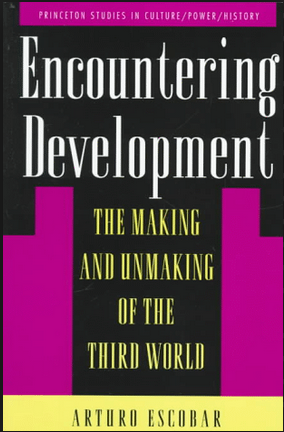
In this hierarchical structure/system, the modern Western development discourse is dominantly or 'unfairly' located at the top – a position contested by post-colonial writers and scholars, like Gandhi, Fanon and Escobar among others. Their main concern is about questioning and deconstructing the established singular development model. Here post-colonial and post-modern thinkers share their rejection to modern hierarchical [managerial] approach but with different reason. Post-colonial thinkers resent this paradigm of hierarchical domination while post-development writer refused to be part of this problematic paradigm altogether. Later the managerial approach developed into professionalism and managerialism as we know it.
Worth noting here is the different strain of post-development approach, for example between alternative development and alternative to development, the former is still part of development while the latter is searching for ways outside ‘development’.
The homogenising ‘development age’
The foundation of modern development can be traced back to the US President Harry S. Truman's inaugural speech in 1949. In his speech, he declares that the ‘economically backward’ former colonies of imperial Europe as ‘underdeveloped’ therefore need to be ‘developed’ [according] to the US/Eurocentric industrialisation program (Truman in Rist, 2002, p.71). Moreover, Truman’s statement also effectively categorised half of the world population as ‘underdeveloped’ without their prior consent – so begins what Gilbert Rist called the ‘development age’.
Modern ‘development’ is a product of a political system, for example Rostow’s ‘Stages of Growth’ linked with ‘Cold War’ politics. The consequence of this politics and policies ‘tied-up’ is development loses its objectivity and becomes dependent on short to medium term (3 to 5 years) elected government politics and values. This description is in line with Escobar's definition of development, i.e. a system consisting of ‘...a set of relations which ensured their continued existence.’(Escobar, 1988, p.430).
In the 1950s modern ‘development project’ [under US management] tools to achieve progress relied on the linear Rostovian ‘Stages of Growth’ method that measures progress in mainly economic terms. This narrow and reductionistic mind-set and method of measuring progress is problematic for both post-colonial and post-development thinkers/theorists alike since it excludes the [local] historical, socio-cultural and knowledge base so important in post-colonial and post-development discourse [of alternative development and alternative to development] (Sidaway, 2008, p.16).
Moreover this homogenising brand of ‘development’ that focus mainly on economic growth is made possible at the high costs of local, regional and global environmental/ecological services destruction. In short, growth-based [economic] development is unsustainable in a resource-limited planet (Wackernagel (2002) in Brown, 2006, p.6).
Post-colonial approach
Post-colonialism literally means ‘after-colonialism’ or ‘after-independence’ however according to Radcliffe (1999) definition it refers to ‘...ways of criticizing the material and discursive legacies of colonialism (Radcliffe in McEwan, 2008, p.124). McEwan embolden the above perspectives to also mean anticolonial (idem.)
These anticolonial [post-colonial] discourses have been identified by McEwan to contain four core issues that is:
- to destabilize the dominant discourse [of past imperial Europe and present Eurocentric modern ‘development’]
- to challenges the usage of language that homogenise [e.g. ‘Third World’; ‘us’ and ‘them’; ‘self’ and ‘other’] found in development writings
- attempts to rewrite history, language and power (knowledge) defined by Western world view
- attempts to recover the recover lost historical and contemporary voices of the marginalized, the oppressed and the dominated, thorough a radical reconstruction of history and knowledge production.(Adapted from McEwan, 2008, pp.124-25)
In this way post-colonial approach challenges the very meaning of mainstream [modern] development discourse.
The following is a brief compilation of ideas espoused by post-colonialism :
- integrate IK(Indigenous Knowledge) system
- criticise destructive modernisation and imperialism
- challenge single-path homogenising development
- analyses words and language [of ‘development’ ]
- analyses practices and institutional expression of ‘development’
- influenced by Marxist socio-political and economic analyses [e.g. exploitation, class-struggles, centre-periphery power relations]
- supports diversity of views and priorities[including non-Western views of feminism]
- belief in power-relations dynamic
- attempts to overcome inequality for non-Western people by linking North – South through ethical trade; fair-trade.
There are several weakness/criticism of post-colonial discourse which includes; first, it becomes the institutional representation of Western-based intellectuals [though they may be of Third World origins]; second, it has grown too theoretical therefore ignorant of real problems facing the Global South; and third, it overlooks economic issues best illustrated by Sylvester (1999), he said , ‘development studies does not tend to listen to subalterns and postcolonial studies does not tend to concern itself with whether subalterns is eating’(Sylvester, 1999 in McEwan, 2008, p.127). However one significant and undisputed contribution of postcolonial studies is ‘it demonstrates how the production of Western knowledge form is inseparable from the exercise of Western power.’(idem).
 Post-development approach
If post-colonialism is a reaction to imperial Europe’s colonial practices expressed through its anticolonial discourses – post-development is a rejection against the hegemony of modern [Western]‘development’ concept and practice since the outcome of this single-path homogenising practices not only failed to provide solution for the problem of poverty, inequity, injustice and environmental destruction but instead exacerbate it further through its [aid] interventions programmes in the global South (Rahnema and Bawtree, 1997).
Post-development according to Jan Nederveen Pieterse is ‘...a radical reaction to the dilemmas of development’ (Nederveen Pieterse in Sidaway, 2008, p.16). However being radical does not mean it is antidevelopment ‘the challenge [for post-development] is to imagine and practice development differently’ as Gibson-Graham suggested (Gibson-Graham, 2008, p.149). While Sidaway saw post-development as ‘a critique of the standard assumptions about progress [modernity], who possesses the key to it and how it may be implemented’ (Sidaway, 2008, p.17).
The following is a limited compilation of ideas found in the Post-Development discourse:
- post-development is about exploring possibilities outside modern [Western] ‘development’ paradigm (i.e. the possibilities of holistic approach to current and future development)
- think locally, act locally (Esteva and Prakash)
- consideration into Ecologically Sustainable Development (Daly, Ecological Economic/Steady-State)
- decoupling from 'specialisation', managerialism, the cult of efficiency and returning the convivial and vernacular
- holistic instead of Cartesian reductionism
- consideration into altruistic development (Schumpeter)
- use of Appropriate Technologies
- non-intervention practice
- reconsideration of identity [i.e. who am I ?] as tool to experiment ‘beyond-development’ condition
- possibility of radical unconditioning of the known
- experimenting with the idea of modernity as limitation.
In the end both of these approach has it place and usage at different conditions [i.e. time, space, cultural background etc]. However both are offshoots of modernity that dates back to Europe’s ‘Enlightenment period’ so can only be compared to a similar tradition [which we do not have] in a globalising world. Modern society is materialistic, individualistic and competitive; armed with advanced science and technology and obsessed with efficiency [managerialism]. But the most dangerous feature of this modern [globalising] society is not because everything about it is bad [there are hospital, man landed on the Moon; Jet plane etc.,] but as Foucault put it, because it is dangerous – here I am referring to its mad love for [economic] ‘development’ aka growth as the only path for progress (Foucault, 1983, p.231-32) in the world.
It seems that the perennial philosophical questions like ‘Who am I?’ or ‘what do I identify myself with?’ is not only valid but may even be the critical missing piece in the intricate and complex puzzle of modern human development. No wonder this seemingly simple question has been asked by sages and the wise for millennia, arguably because without sufficient knowledge of the self how can we choose to develop properly or for that matter what to develop first? If this is the case then the development industries should first think about priority.
Conclusion
Perhaps the last 60 years or so of modern development with its emphasis on industrialisation and economic growth need urgent rethinking and reconsideration in the 21st century. This short 60 years of progress or development will be long remembered into posterity as the defining period in what Jeffrey Sach refers to as the ‘Anthropocene’ age. The dilemma of this age will be staged in about one month time at the Copenhagen Climate Summit, and how modernity will response and prioritise between its short-term [economic] ‘development’ goals will determine the Earth’s long-term homeostasis capacity. Let’s hope that those democratically elected leaders from powerful nations made a conscientious decision for the benefit of all.
Let us hope we will be remembered for our intelligence, quick actions and long term wisdom and not for our short-sightedness, greed and selfishness. Perhaps the key to true development cannot be found in being more modern, more sophisticated or [technologically] powerful but in human ability to intelligently live with less quantity and more quality, as Mahatma Gandhi once said, ‘there is enough for everyone's need but not enough for everyone's greed.’ Drawing inspiration from Gandhi, post-colonial relentless critical questioning in combination with post-development meditative soul searching ways may help [development] thinkers to find the answer.
References
Escobar, A. (1988), ‘Power and Visibility: Development and the Invention and Management of the Third World’, Cultural Anthropology, 3(4): 428-443.
Esteva, G. (1992). Development. In W. Sachs (ed.), The Development Dictionary (p. 6). London: Zed Books.
Foucault, M. (1983). “On the Genealogy of Ethics,” in Michel Foucault: Beyond Structuralism and Hermeneutics, in H. L. Dreyfus and P. Rabinow, (2nd ed.) Chicago: The University of Chicago Press, pp.231-32.
Gibson-Graham, J. K. (2005). ‘Surplus Possibilities: Post-development and Community Economies.’ Singapore Journal of Tropical Geography, 26(1), p.6).
McEwan, C. (2008). ‘Indigenous Knowledge and Development’, in: V. Desai and R.Potter (eds.). The Companion to Development Studies. London: Hodder Education, pp.125-129.
Nandy, A., 1997 in M. Rahnema and V. Bawtree , (2003), ‘Colonization of the Mind ‘, in The Post-Development Readers. London: Zed Books, Box: Said on Fanon, p.178.
McMichael, P. (2008), Development and Social Change. A Global Perspective. Thousand Oaks, CA.: Sage, Chapter 2 ‘Instituting the development Project’ pp.24-54.
Nederveen Pieterse in Sidaway, (2008). ‘Post-development’, in: V. Desai and R.Potter (eds.). The Companion to Development Studies. London: Hodder Education, pp.16-18.
Radcliffe in McEwan, C. (2008). ‘Indigenous Knowledge and Development’, in: V. Desai and R.Potter (eds.). The Companion to Development Studies. London: Hodder Education, pp.125-129.
Rahnema, M. and V. Bawtree, (2003) 4th edition, The Post-Development Readers. London: Zed Books.
Rist, G. (2002). The History of Development. London: Zed Books, Chapter 4 ‘The Invention of Development’, pp.69-79.
Sidaway, J. ( 2008), ‘Post-development’, in: V. Desai and R.Potter (eds.). The Companion to Development Studies. London: Hodder Education, p.16.
Sidaway, J. (2008), ‘Post-development’, in: V. Desai and R.Potter (eds.). The Companion to Development Studies. London: Hodder Education, p.17.
Sylvester, 1999 in McEwan, C. (2008), ‘Post-colonialism’, in: V. Desai and R.Potter (eds.). The Companion to Development Studies. London: Hodder Education, p.127.
Truman, 1949 in Rist, G. (2002). The History of Development. London: Zed Books, Chapter 4 ‘The Invention of Development’, p.71.
Wackernagel, M. (2002) in L. Brown (2006). Plan B 2.0: rescuing a planet under stress and a civilization in trouble. New York: W.W. Norton & Company.
Sunday, 27 March 2011
Monday, 24 November 2008
Ecoliteracy: EE, ESD, EfS, Earth Education - Ivan Fukuoka
Introduction
The root cause of global environmental problems can be traced to a large extent to the currently dominant neoliberal industrial-capitalistic ideology, its derivative the neoclassical economic system and its cult of managerialism. Central to this belief is the [obsolete] assumption of unlimited economic growth driven by consumerism and consumption is possible. However, we must remember that centrally planned socialist or communist and "semi-socialist" state economic systems like China and Russia are also equally responsible for the destruction of their respective local/regional environments too.
The trouble with maintaining growth-economy that relies endlessly on converting natural resources faster than its regeneration is that it is not possible on two counts – first, the planet has limited reserves of natural resources and second, the Earth's growing population demands have surpassed the regenerative capacity of the planet (Wackernagel (2002) in Brown, 2006, p.6). This unsustainable practice is further exacerbated by modern industrial society education system as schools and universities continue to teach neoclassical [i.e.growth-economy] rather than steady-state or ecological economics to students.
The clarion [economic] call here is to live within the means of our ecological regenerative interests [i.e. sustainable] and not on the principal reserves of ecological capital [i.e.unsustainable]. In financial term this situation is call a debt which is clearly not a sustainable way to live on a finite planet.
The clarion [economic] call here is to live within the means of our ecological regenerative interests [i.e. sustainable] and not on the principal reserves of ecological capital [i.e.unsustainable]. In financial term this situation is call a debt which is clearly not a sustainable way to live on a finite planet.
Further examination revealed that the underlying causes of unsustainable activities are usually unaddressed or ignored social problems (i.e. inequality, poverty, injustice etc). It is a systemic [human] problem of values and vision, of motive and meaning as well as of ethics and ideologies – these are the real root of environmental problems. Ecological Footprint proponent Professor William Rees put it this way, ‘…the “environmental crisis” is less an environmental and technical problem than it is a behavioral and social one’ (Rees, 1996, p.xi). To which he concluded that ‘it can be resolved only with the help of behavioral and social solutions’ (ibid.).
As the ‘environmental crisis’ alarm continues ringing the public (led by academics, scientists, radical educators and activists) are awaken and became conscious of the underlying cause of our environmental problems. A quick look at today’s news and magazines will display the planet-wide ecological destruction as scientific reports and studies from almost every parts of the world confirmed that the ‘environmental crisis’ is not only continuing but progressively worsening (Sachs,1996, p.243). Some with unprecedented direct/indirect local, national/regional and global consequences for human like climate change, food/water shortages, dwindling oil reserves etc. The planet-wide reality is this, unlimited conversion of natural resources or ecological capital (i.e. forests, oceans, fauna and flora including indigenous civilisations) into commodities for trades and consumption will have adverse ecological effects on the whole planet ecosystems. And this may interfere seriously with the provision of free ecological services such as fresh air, water availability, agreeable climate etc.
Environmental education (EE) particularly Education for Sustainability (EfS) and its many variants (i.e. Education for Sustainable Living, Education for Sustainable Future etc.) are instrumental in transmitting the concepts, values and principles of planetary ecological sustainability into public consciousness. When the transmission is successful and understood and formed strong ecological worldview then the next step would be the implementation or practice of this worldview so that the goal of achieving ecologically sustainable society is possible. However, we must understand that education cannot achieve this goal alone - it must work in cooperation and in synergy with other transformative agents of [social and cultural]change who shared similar goal in all walks of life.
The context: Sustainable Development is Qualitative Improvement
Before we proceed, I would like to mention about the two types of ‘sustainable development’ approach. The first approach is the ‘flexible’ sustainable development approach of the ‘Brundtland Report’ (WCED, 1987) which was endorsed during the Rio Earth Summit (UNCED, 1992) and later co-opted by pro-growth neoliberal forces in the second Earth Summit (WSSD, 2002), Johannesburg, South Africa. This approach has been subject to much controversy and criticism by ecocentric leaning groups and supporters. They argued about its proximity with pro-growth/status-quo proponents which are part of the problem.
And the second type is the ‘genuine’ sustainable development approach which calls for the reduction of [economic] growth to achieve a ‘steady-state-economy’ through ecologically sustainable development pathway. This school of thought is supported by scholars and thinkers from the Club of Rome with their report Limits to Growth (Meadows et al.) and by those inspired by the ideals of E.F. Schumacher’s book Small is Beautiful. Thus sustainable development becomes the arena for two contesting worldviews of sustainability – the pro-growth technocentrism and the pro-development ecocentrism. These two perspectives are identified by Turner (1988) as ‘...the sustainable growth and the sustainable development modes of thinking’ (Turner in J.Fien and T.Trainer, 1993, p.30).
Consumerism popularised through various media and powered by global transnational corporations created an almost homogenised model of economic aspiration. This condition is particularly true for many third world countries with access to ‘western’ culture and is well represented by the ‘American Dream’. As observed by Carley and Spapen: “The consumption patterns represented by the American dream, encouraged by global marketing, television and advertising, condition social and economic aspiration of people and households around the world” (Carley and Spapens, 1998, p.29). Hence, prolonging the cycle of consumption and consequently further depleting the world’s finite resources.
UNSW's academic Dr Ted Trainer remind us that ‘...the core problems in our economy derive from the fact that it is a free enterprise or free market system. Participants are free to produce, purchase and work as they as individuals wish. This sounds ideal, but unless an economy is under considerable social control it will mostly serve the rich and powerful and deprive the poor.’(Trainer, Website, 1995).
The founder of ecological economy Professor Herman Daly explains that ‘...the term sustainable development is used as a synonym for the oxymoronic sustainable growth’ he further added that ‘[i]t must be saved from this perdition’ of misunderstanding (Daly, 1996, p.193 in J. Mander and E. Goldsmith). He did so by making a clear distinction between the meaning of growth and the meaning of development – growth in his view is quantitative physical expansion whereas ‘development’ is qualitative improvements. He then defines sustainable development as ‘...a process of qualitative improvement without quantitative increase beyond environmental [regenerative and absorptive] capacity’ in other words ‘development without growth’ (Daly, 1996, p.18-9). And considering that we all live within a finite and non-growing planet, I think it made complete sense for sustainable development to be identified as qualitative improvement and not with quantitative [economic] expansion of sustainable growth. To me this ecologically based sustainable development is the true mark of genuine sustainable development.
Table 1 – This graph shows that human has exceeded consuming one planet around mid 1980s.
 |
| Sometime in mid 1980s the world has past consuming one planet! |
Disposable Planet, BBC website retrieved on 01 Sept 2008 from http://news.bbc.co.uk/hi/english/static/in_depth/world/2002/disposable_planet/big_picture/
- It would take 1.2 Earths to regenerate resources at the rate we are using them.
- Humans started to exceed nature's ability to regenerate from the mid-1980s onwards.
- In 1961 humans were using 70% of the capacity of the global biosphere. By 1999, that had risen to 120%.(Source: PNAS, adapted from “Disposable Planet”, bbc.co.uk website)
So it is now clear that the concept of ‘sustainable development’ as growth is misleading and is undeniably ‘part of the problem’ whereas the notion of ‘sustainable development’ as qualitative improvement is ‘part of the solution’ for social-environmental problems. The challenge ahead for those who have seen and understood the root of the problem is to assist the transformation process from the old social-economic regime of growth towards a more holistic and ecologically sustainable paradigm. In this context [environmental] education plays the critical role of guiding and ensuring smooth transition towards the ecologically sustainable global society – by steering the currently reductionist-mechanistic-Cartesian ‘traditional’ education system towards a more inclusive ecologically based environmental education (i.e. Education for Sustainability, Education for Sustainable Living, and Educating for Sustainability) in which principles, languages and stories of ecological sustainability are prominently featured, studied and practiced (Capra and Pauli, 1995, pp.2-3).
Education for SD (ESD) – More conventional approach to EE
ESD evolved from many past conferences that involve educators. This can be traced back to the first United Nations Conference on the Human Environment (1972) in Stockholm, Sweden which endorsed environmental education to address increasing environmental problems (i.e. pollutions) as the result of industrialisation. ESD is a vision of education that seeks to balance human and economic well-being with cultural traditions and respect for the earth’s natural resources through transdisciplinary educational approaches to achieve a sustainable future (CEE India,(n.a)).
The concept of sustainability contained in the ‘Brundtland Report’ (WCED, 1987) was originally developed from early 1980s by Lester Brown, the founder of the Worldwatch Institute – ‘[he] defined a sustainable society as one that is able to satisfy its needs without diminishing the chances of future generations’ (Brown (1981) in Fritjof Capra, 2002, p.200). However as noted by Capra, ‘...this definition does not tell us anything about how to build a sustainable society’ (ibid.) within the Earth’s ecological limits.
Thereafter the World Commission on Environment and Development (WCED, 1987) and its publication ‘Our Common Future’ defined the concept of 'SD' as ‘...development that meets the needs of the present without compromising the ability of future generations to meet their own needs’. Previously, environment and development tended to be thought of as two separate areas – the need for [economic] development on the one hand and the need to protect the environment on the other. During the 1992 Earth Summit in Rio de Janeiro, the main focus of SD appeared to be the environmental side. While the social aspects like poverty [social-injustice] though seen as important it was not on priority in the main documents from the Earth Summit (i.e. Rio Declaration and Agenda 21). Instead the emphasis is more on protecting the natural environment through a global partnership to conserve, protect and restore the health and integrity of the Earth’s ecosystem.
A decade later a more integrated model of SD approach was endorsed at the World Summit on SD (WSSD, 2002) in Johannesburg, South Africa. Its declaration states that sustainable development is built on three interdependent and mutually reinforcing pillars of—economic development, social development and environmental protection—which must be established at local, national, regional and global levels (WSSD, 2002). WSSD model had a strong emphasis on the socio-economic aspects such as poverty, inequity, poor quality of life and associated human suffering while still highlighting how current actions are leading to environmental degradation. And its inter-sectoral approach appeared to be geared for better quality of life for everyone now and for the generations to come – which means it seeks to secure long-term [strong] sustainability.
However, there are unfinished ‘homework’ from the ‘Brundtland Report’ on issues concerning unclear definition of SD and questions like – ‘whose development needs?’ and ‘whose future generations?’ – raised by the South remains unanswered. Furthermore, the underlying issues of inequality due to unrestrained growth-economy, unregulated financial markets and its repercussions are avoided from being discussed in Johannesburg. With this burden of unresolved issues and criticisms in the background it will be difficult to expect any real paradigm shift or transformation to emerge from ESD programmes sponsored or endorsed by the United Nations. In addition, the culture/characteristic of ‘democracy’ in the UN assembly itself is an impediment as it is [mainly] dictated by dominant member nation/s (i.e. the US, Russia, China) thus preventing it from exercising decisive power. In short, the UN (and its agencies) is not an effective agent to implement radical socio-ecological change.
Education for Sustainability (EfS) [More radical approach to EE]
Education for sustainability was the result of many international agreements (WCED 1987, Rio Earth Summit 1992, Johannesburg WSSD 2002) and the global call to actively pursue sustainable development. The interesting difference is that it facilitates new orientation for current practice in environmental education and environmentalism.
Some of the new and distinctive components in EfS are its systemic and critical thinking approach towards achieving a sustainable society. This is done by encouraging learners [and educators] to think beyond treating symptoms like raising awareness or involve in a one-off environmentally friendly activities. But to ‘think-through’ employing critical and systemic thinking to identify the root cause of the issues then work actively towards positive outcomes (Tilbury, D. and Cooke, K. (2005) in Aries).
It also regards people not as the problem instead it views them as agent of change in whatever level of their involvement in life. And more radically it challenges the concept of integration by arguing that integration maintained the status-quo and does not challenge unsustainable practice because it is transformation and innovation that lie at the heart of sustainability.
This new orientation attempts to move beyond education in and about the environment approaches to focus on equipping learners with the necessary skills to be able to take positive action to address a range of sustainability issues. Education for sustainability [supposedly]motivates, equips and involves individuals, and social groups in reflecting on how we currently live and work, in making informed decisions and creating ways to work towards a more sustainable world. Supported by the principles of critical theory, EfS aims to go beyond individual behaviour change and seeks to engage and empower people to implement systemic changes (Tilbury, 2004 in Aries).
After reviewing the main theme in EfS, which is critical and systemic thinking approach. I think the approach will have to overcome the challenge in its implementation because historically speaking radical ideas flourish when there is a person, a character which has been exemplified by many educators (i.e. Montessori, Friere or the Buddha). So shifting from symptom-based treatment to a more thoughtful process of critical and systemic thinking requires fairly developed [western-education] and limited participants.
Education for Sustainable Living/Futures: Developing Ecological Literacy
Education for Sustainable Living/futures (EfSL) originates from the awareness that current [traditional] education system is not geared for living sustainably therefore inconsiderate of future generation needs and requirements. To live sustainably according to Fritjof Capra we do not have to reinvent the wheel. He said we can learn from older sustainable societies or mimic or copy nature, he further added ‘…[that] the outstanding characteristic of the biosphere is its inherent ability to sustain life, a sustainable human community must be designed in such a manner that its technologies and social institutions honor, support, and cooperate with nature's inherent ability to sustain life’ (Capra, n.d.)
There are many important similarities between EfS and EfSL. Among them are the shift from structure to process; from parts to the whole (holistic-view); from objective to contextual knowledge and the prominent one being its systemic view and approach towards education. EfSL also shares at least one significant similarity with ESD, which is its focus on quality instead of quantity.
EfSL such as embodied in ecological–literacy concern itself with principles and values that foster respect for Nature’s biogeochemical cycles and processes this must be facilitated and promoted at all level of EfS. Because when a person, a community or business is ecologically illiterate then it reduces the possibility to achieve sustainable futures. Borrowing from David Orr rather funny but serious comments is that: ‘...ecological illiterates...will have roughly the same success as one trying to balance a checkbook without knowing arithmetic’ (Orr, 1992, p.86).
When ecoliteracy becomes the norms and widely understood by the majority of the planet citizens then the goal of building an ecologically sustainable society is closer to realisation. Education for sustainable living when implemented properly will insure that everyone will have a sustainable future living on this planet.
Conclusion
Conclusion
“[T]he concept of sustainable development did emerge as a means of combining economic and ecological needs” (Odum and Garret, 2005, p.468). And the goal of sustainable development is sustainability, a journey and destination that is to be [socio] culturally negotiated. (Aries,n.a.)
The first priority for any true citizen of this Earth is to learn and realised that the primary goal of sustainability is to live within our environmental/ecological limits. To do so, what we need is not better technologies or new ideologies but social-intelligence, such as sensitivity, care and respect – convivial and vernacular capacities we used to have and experienced but now lost or forgotten in our quest for being ‘civilised’, sophisticated and super-modern – to the point that we care-less for life and care more for the lifeless.
When this happened frequently then it’s time to rethink and reconsider all our basic assumptions, models and paradigms. EE, ESD, EfS and others like education for sustainable living/futures provide the tools to reorient our direction towards appreciating life and the living – a condition and tendency commonly found in our young. Eminent biologist Professor E.O. Wilson call it ‘Biophilia’.
Because in the end what is the use of having an educated person whose character cannot appreciate life or the living. Otherwise what radical author Derrick Jensen said about '...civilisation is inherently unsustainable' (Jensen, 2008) can be further elaborated to include industrial civilisation is absolutely unsustainable—will soon be a reality.
References
Brown, L. (1981) in Fritjof Capra (2002), The Hidden Connections (p.200). London: HarperCollinsPublishers.
Elliot, J. (1999). An Introduction to Sustainable Development (2nd edition). London: Routledge.
Fien, J and Trainer, T. (1993). A Vision of Sustainability. In J. Fien (Ed.) Environmental Education: A Pathway to Sustainability (p.29). Geelong, Victoria: Deakin University Press.
Capra, F. (2002). The Hidden Connections. London: HarperCollinsPublishers.
Capra, F and Pauli, G. (Eds.) (1995). Steering Business Toward Sustainability (pp.2-3). Tokyo: The United Nations University
Capra, F. System thinking. Retrieved from http://www.ecoliteracy.org/education/sustainability.html on 22 October 2008.
(n.a.).CEE India retrieved from http://www.ceeindia.org/esf/esd.asp on 22 October 2008.
Carley, M and Philippe Spapens, (1998). Sharing the World: Sustainable Living and Global Equity in the 21st Century. London: Earthscan
Daly, Herman E. (1999). Ecological Economics and the Ecology of Economics: Essays in Criticism, Cheltenham, UK: Edward Elgar Publishing.
Daly, Herman E. (1996) Sustainable Growth? No Thank You. In J. Mander and E. Goldsmith (Ed.). The Case Against The Global Economy: and for a turn toward the local (p.193). San Francisco: Sierra Club.
Disposable Planet, BBC website retrieved on 01 Sept 2008 from http://news.bbc.co.uk/hi/english/static/in_depth/world/2002/disposable_planet/big_picture/
Jensen, D. (2008). Personal communications.
Meadows, H.D., Meadows, D.L. and Randers, J. (1992). Beyond the limits: global collapse or a sustainable future. London: Earthscan Publications.
Tilbury, D. and Cooke, K. (2005) A National Review of Environmental Education and its Contribution to Sustainability in Australia: Frameworks for Sustainability. Canberra: Australian Government Department of the Environment and Water Resources and Australian Research Institute in Education for Sustainability. In Aries website, retrieved from http://www.aries.mq.edu.au/portal/about/relationship.htm#innovation on 22 October 2008.
Trainer, T. (F.E.) The Simpler Way: Analysis of global problem. Retrieved 18 May 2005, from http://socialwork.arts.unsw.edu.au/tsw/09c-Our-Economic-System.html
Odum, E. P. and Barret, G.W. (2005). Fundamentals of Ecology (5th edition). Belmont, CA: Thomson Brooks/Cole.
Ophuls, W. and Boyans, Jr. S.A. (1992). Ecology and the Politics of Scarcity Revisited: The unravelling of the American Dream. New York: W.H.Freeman and Company.
Orr, D. (1992). Ecological Literacy: Education and the Transition to a Postmodern World. New York: State University of New York Press.
Sachs, W. (1996) Neo-Development: “Global Ecological Management”. In J. Mander and E. Goldsmith (Ed.) The Case Against The Global Economy: and for a turn toward the local (p.243). San Francisco: Sierra Club.
Wackernagel, M. (2002) in L. Brown (2006).Plan B 2.0: rescuing a planet under stress and a civilization in trouble. New York: W.W. Norton & Company.
Wackernagel, M. and Rees, W. (1996). Our Ecological Footprint. Gabriola Island, B.C., Canada: New Society Publishers.
Subscribe to:
Posts (Atom)